Virtual Walkthroughs vs Traditional Photos: Which Boosts Property Sales More?
That's the gap most sellers and agents hit. Traditional photos look good on screen, but they leave the buyer guessing. How big is that living room actually? Does the kitchen flow into the dining area? A 3D virtual walkthrough answers those questions before anyone picks up the phone. This blog breaks down what both options actually do for sales, and which one is worth your time and money in 2026.
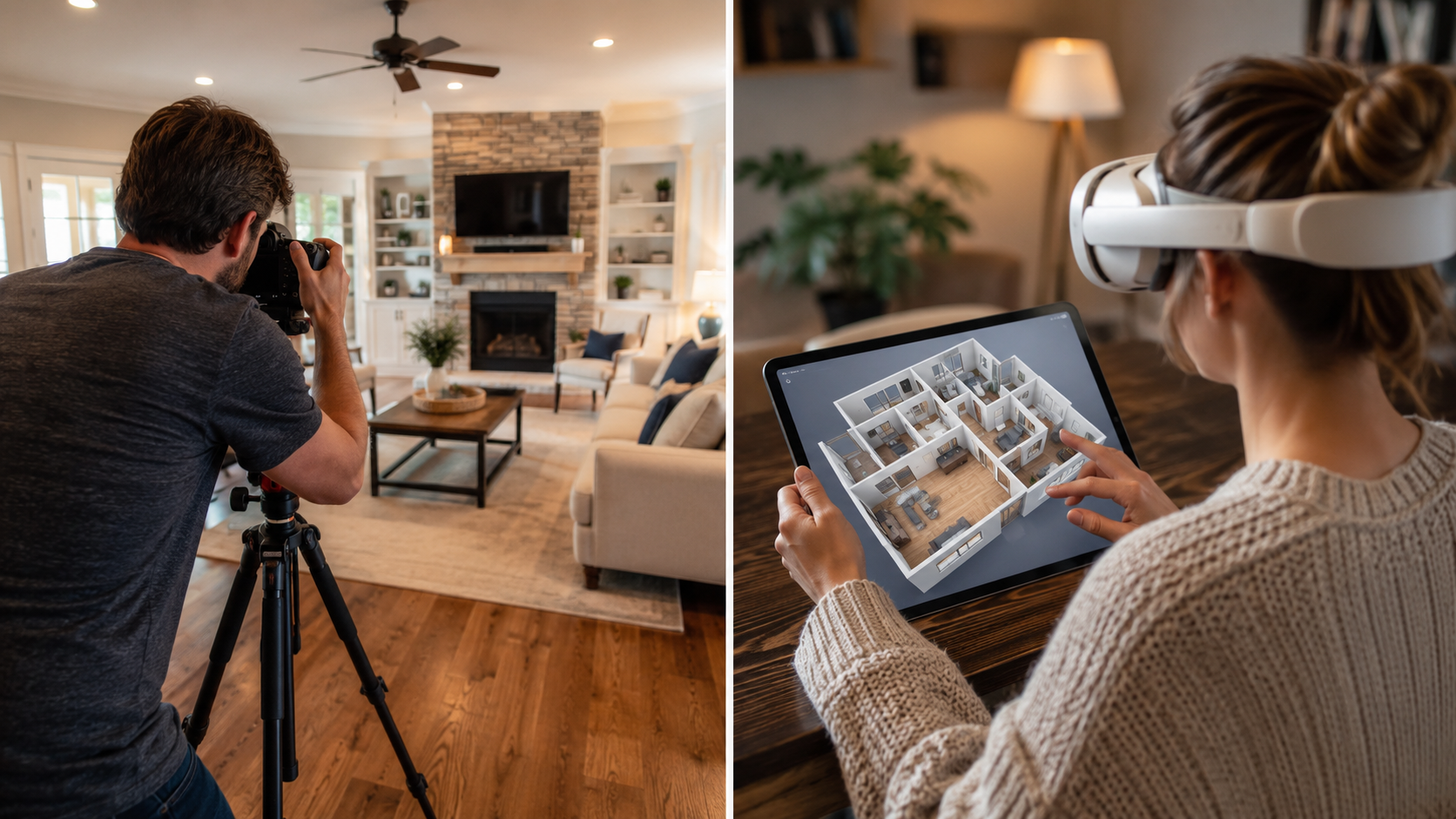
What a Traditional Photo Actually Shows (And What It Hides)
Real estate photos have been the standard for decades. A good photographer, nice lighting, wide-angle lens — and a property looks polished online.
But photos are selective. You see what the photographer chose to show you. That corner cabinet hiding a structural crack? Gone. The awkward hallway that makes the master bedroom feel cut off? Cropped out. The low ceiling in the second bedroom? Forget it.
Buyers know this. They've learned to read between the lines of a listing. And when they're unsure, they either don't visit at all, or they visit expecting one thing and find another. Both outcomes waste time — yours and theirs.
Photos are also passive. You look at them. You don't move through them. There's no sense of depth, no understanding of how one room connects to the next. For a local buyer, this might be fine. They'll come see it in person. But for someone relocating from another city? A folder of JPEGs doesn't close deals.
What a 3D Virtual Walkthrough Actually Does
A 3D virtual walkthrough puts the buyer inside the property before they set foot in it.
With tools like Matterport — which is what Edge 3D uses — the entire space gets captured in three dimensions. Every room, every corner, every transition between spaces. The buyer can click through at their own pace, look up at the ceiling height, step into the bathroom, check how the light comes into the kitchen at that angle.
It's not a video. You're not watching someone else walk through the property. You control it. That difference matters more than it sounds. When a buyer feels like they've already been inside a property, their confidence in making a decision goes up. They've already answered their own questions. They're not walking in blind.
For sellers, this means fewer no-shows, fewer "it wasn't what we expected" visits, and more conversations with people who are already partly sold.
The Numbers Don't Lie
Properties with interactive 3D tours get more engagement than those with photos alone. Buyers spend more time on the listing. They come back to it. They share it.
When someone can explore a property from their phone at 10pm on a Wednesday, you're reaching people who would never schedule a daytime viewing. That's a real pool of buyers you're otherwise missing.
In markets where competition is high, the listing with a walkthrough stands out. Not because it looks fancier — but because it gives more useful information, faster.
Agents who've switched to virtual walkthroughs for their premium listings consistently report better-qualified leads showing up to physical viewings. The tyre-kickers get filtered out at the virtual stage. The people who call have already decided they like what they see.
Where Traditional Photos Still Make Sense
Photos are cheaper. For a studio flat or a budget rental, a walkthrough might be more investment than the return justifies. Photos also load fast, work on any device without issues, and require zero tech comfort from the viewer.
If you're selling something simple and local, photos still do the job. There's no point overcomplicating a sale that doesn't need it.
But for mid-range to premium properties, for commercial spaces, for out-of-town or international buyers — photos alone are leaving money on the table.
Beyond Real Estate: Other Places Virtual Walkthroughs Win
Property isn't the only space where this technology proves its worth.
Industries that require detailed site documentation use virtual walkthroughs alongside 3D laser scanning services. Think about a facility manager who needs to show a maintenance team the exact location of equipment inside a large plant. Or a heritage site that needs to be documented before restoration work begins.
Edge 3D, for instance, works across construction, marine, oil and gas, and industrial sectors. A 3D virtual walkthrough of a vessel or an offshore facility is a completely different use case from real estate — but the core value is the same. You're giving someone who can't physically be there a way to understand a space in three dimensions.
This kind of documentation is also useful for as built documentation, where the goal is to capture exactly what was built versus what was planned. Photos capture surfaces. A 3D walkthrough captures spatial relationships. Those are different things.
What to Actually Look For in a Provider
If you're thinking about getting a virtual walkthrough done, here's what actually matters:
Equipment quality. Matterport cameras produce a noticeably different result from consumer-grade 360 cameras. The point cloud density and the stitching quality show up in the final output. Don't let someone with a cheap camera tell you it's the same thing.
Experience with your space type. A residential photographer and a company experienced in industrial or marine environments are not interchangeable. The technical challenges are different. Ask for examples from similar projects.
Output formats. Your walkthrough needs to work embedded in your website, shared on WhatsApp, and loaded on a tablet during a site visit. Make sure your provider delivers formats that actually fit your workflow.
Turnaround time. In a competitive market, a listing that goes live a week late because the walkthrough isn't ready costs you.
So, Which One Wins?
For a buyer in another city who's deciding whether to fly in for a viewing, a 3D virtual walkthrough wins every time. For a landlord renting a one-bedroom flat to someone who lives five minutes away, photos are probably enough.
The honest answer is: it depends on your buyer, your property, and how much you want to filter for serious interest before spending time on physical viewings.
But the trend is clear. Buyers have more information available to them than ever before. They expect more from listings. Properties that give them that — through a walkthrough, not just a photo gallery — are getting more engagement and closing faster.
If your property deserves serious attention, give buyers a serious way to explore it.
FAQs
1. What is a 3D virtual walkthrough? It's an interactive, digital tour of a real space that you can explore on your phone or computer. You click or tap to move through rooms, look around, and get a real feel for the layout — without physically visiting.
2. Is a virtual walkthrough better than photos for selling property? For most mid-range and premium properties, yes. Buyers spend more time on listings with walkthroughs, feel more confident, and show up to physical viewings better prepared. Photos are faster and cheaper but don't give buyers the same spatial understanding.
3. How much does a virtual walkthrough cost? It varies depending on the size of the property, the equipment used, and the provider. Matterport-based walkthroughs are generally priced per project or per square foot. It's worth requesting a quote based on your specific space.
4. Can a virtual walkthrough be used for commercial properties? Absolutely. Virtual walkthroughs work well for offices, retail units, warehouses, industrial facilities, and more. Some companies also use them for safety training and facility management.
5. How long does it take to create a virtual walkthrough? For most residential properties, the scanning itself takes a few hours. Processing and delivery usually take one to two days, depending on the provider.
6. Can I share a virtual walkthrough on social media? Yes. Most Matterport walkthroughs generate a link you can share on WhatsApp, email, or social media. They can also be embedded directly into websites.
7. Do buyers actually use virtual walkthroughs? Yes. Studies show buyers engage significantly longer with listings that have interactive tours compared to photo-only listings. With more people searching for properties from different cities or countries, walkthroughs have become a practical necessity.
8. What equipment is used to create a 3D virtual walkthrough? Professional providers like Edge 3D use Matterport cameras, which capture spaces in high resolution 3D. This produces a far more accurate and immersive result than standard 360-degree cameras.
9. Are virtual walkthroughs only for new or premium properties? No. They work for resale properties, rentals, commercial units, and even historical or heritage buildings. The key question is whether the cost makes sense for the property's value and the target buyer.
10. How is a virtual walkthrough different from a video tour? A video tour shows you what someone else chose to film, in the order they filmed it. A virtual walkthrough lets you move through the space yourself, look wherever you want, and explore at your own pace. That control makes a big difference in how buyers experience the property.
#3d virtual walkthrough #3d laser scanning services #as built documentation